Strategic Research for Positive Impact Businesses
Whatsapp Linkedin Instagram CASES Strategic Research for Positive Impact Businesses The challenge Global markets are shifting rapidly, and companies with

Sustainability, inequality, and governance crises have put ESG at the center of corporate agendas. Leaders are now expected to embody purpose and credibility in public. Platforms like LinkedIn have amplified this demand, transforming leadership into a hybrid performance that combines institutional authority with personal visibility. Yet research shows that men and women face different expectations in how they communicate, shaping who is seen as legitimate in this new arena.
This tension exposes a critical gap: while companies measure ESG performance in numbers and reports, they rarely address the symbolic and cultural dimensions of leadership that sustain inclusion. Without this layer, many D&I initiatives remain surface-level campaigns — disruptive but unsustainable. The challenge is to design transitions that are strategic, equitable, and culturally grounded, so inclusion and diversity can move from visibility to legitimacy.
This was the focus of my Master’s research at TISE: Gender Differences in Approaching Sustainability: An Analysis of Multinationals’ CEOs on LinkedIn. The study examined how CEOs communicate ESG commitments online, and how credibility and legitimacy are shaped by gendered leadership patterns. By analyzing 682 LinkedIn posts from 40 CEOs, the research revealed distinct rhetorical strategies and future framings — showing that leadership is not only exercised, but also performed under gendered expectations.
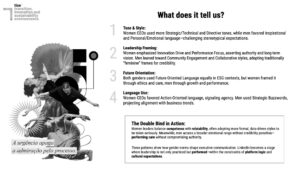
Instead of focusing only on ESG performance indicators, the research applied a discourse-analytic lens that uncovers how legitimacy is built through language, narrative, and symbolism. It combined gender studies, sustainability theory, and digital platform analysis to reveal:
This methodology offers companies a complementary layer of ESG analysis: moving beyond compliance and reporting, to understand the cultural and symbolic dimensions of leadership that directly affect inclusion.
For organizations, this translates into practical applications:
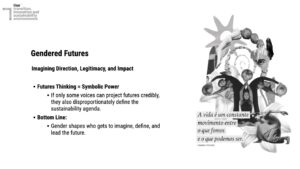
The research demonstrates that sustainable inclusion is not about quick campaigns or disruptive shifts. It’s about cultivating transitions that expand what counts as leadership, voice, and authority. By integrating symbolic analysis into ESG, companies can move beyond metrics and embed equity into the way they imagine — and communicate — the future.

